Kyoto Festivals Guide: Annual Events and Cultural Traditions in Japan
Experience the soul of Japan’s former capital through its seasonal celebrations. This guide covers Kyoto's major events, including the historic Jidai Matsuri, the Gion Matsuri float processions, and elegant geisha performances, perfect for travelers seeking authentic cultural immersion.
A Guide to Kyoto’s Annual Festivals and Cultural Traditions
Kyoto is a city where history remains a living presence, largely defined by a calendar full of spiritual rituals, seasonal celebrations, and ancient performances. From massive street parades to intimate temple light-ups, these events offer a window into the soul of Japan’s former imperial capital.
Winter: New Year Traditions and Good Fortune
Hatsumode (January 1–3) The year begins with Hatsumode, the first shrine visit of the New Year. Thousands of residents and visitors flock to major sites like Fushimi Inari-taisha and Yasaka-jinja to pray for health and success. [cite_start]It is a time of dense crowds, steaming cups of sweet amazake, and the scent of burning incense[cite: 140, 141].
Toka Ebisu (January 8–12) [cite_start]Centered at Ebisu-jinja Shrine, this festival honors Ebisu, the god of prosperity[cite: 142, 145]. Business owners and those seeking financial luck visit to purchase lucky bamboo branches. [cite_start]A unique local custom involves banging on a wooden board at the side of the main hall to ensure the "hard of hearing" deity notices your prayer[cite: 147, 148].
Setsubun (February 2–3) [cite_start]Marking the transition from winter to spring on the lunar calendar, Setsubun is a ritual of purification[cite: 150]. [cite_start]It is famous for the practice of throwing roasted soybeans (mame-maki) to drive away demons and welcome good luck[cite: 151, 152]. [cite_start]Major celebrations featuring geiko and dance performances take place at Yasaka-jinja and Heian-jingu shrines[cite: 154].
Spring: Geisha Dances and Imperial Pageantry
Higashiyama Hanatoro (Early to Mid-March) [cite_start]The historic streets of Southern Higashiyama are transformed by thousands of illuminated lanterns[cite: 156]. [cite_start]This "Flower and Light Path" connects Maruyama-koen Park with various temples, creating a luminous evening atmosphere for walkers[cite: 157, 158].
Geisha Dance Seasons (March – May) Kyoto’s five geisha districts (hanamachi) host annual public performances that are highlights of the spring:
- [cite_start]Kitano Odori (Late March – Early April): An intimate performance in the northern Kamishichiken district[cite: 161, 162].
- [cite_start]Miyako Odori (All of April): The most famous and grandest of the dances, held in the Gion district with elaborate sets and numerous performers[cite: 171, 172].
- [cite_start]Kyo Odori (Early to Mid-April): Hosted by the Miyagawa-cho district, known for high-quality choreography[cite: 166].
- [cite_start]Kamogawa Odori (May): Performed by the geiko of Pontocho in a theater overlooking the Kamo River[cite: 176].
Yabusame Shinji (May 3) [cite_start]Held at Shimogamo-jinja Shrine, this event showcases the art of Japanese horseback archery[cite: 179]. [cite_start]Archers dressed in traditional hunting gear fire arrows at targets while galloping at full speed through the Tadasu-no-mori forest[cite: 180].
Aoi Matsuri (May 15) [cite_start]One of Kyoto's three major festivals, the "Hollyhock Festival" features a large-scale procession from the Imperial Palace to the Kamo Shrines[cite: 181, 183]. [cite_start]Participants are dressed in elegant Heian-period costumes, recreating a 6th-century imperial retinue[cite: 182].
Summer: The Great Gion Matsuri and Fire Rituals
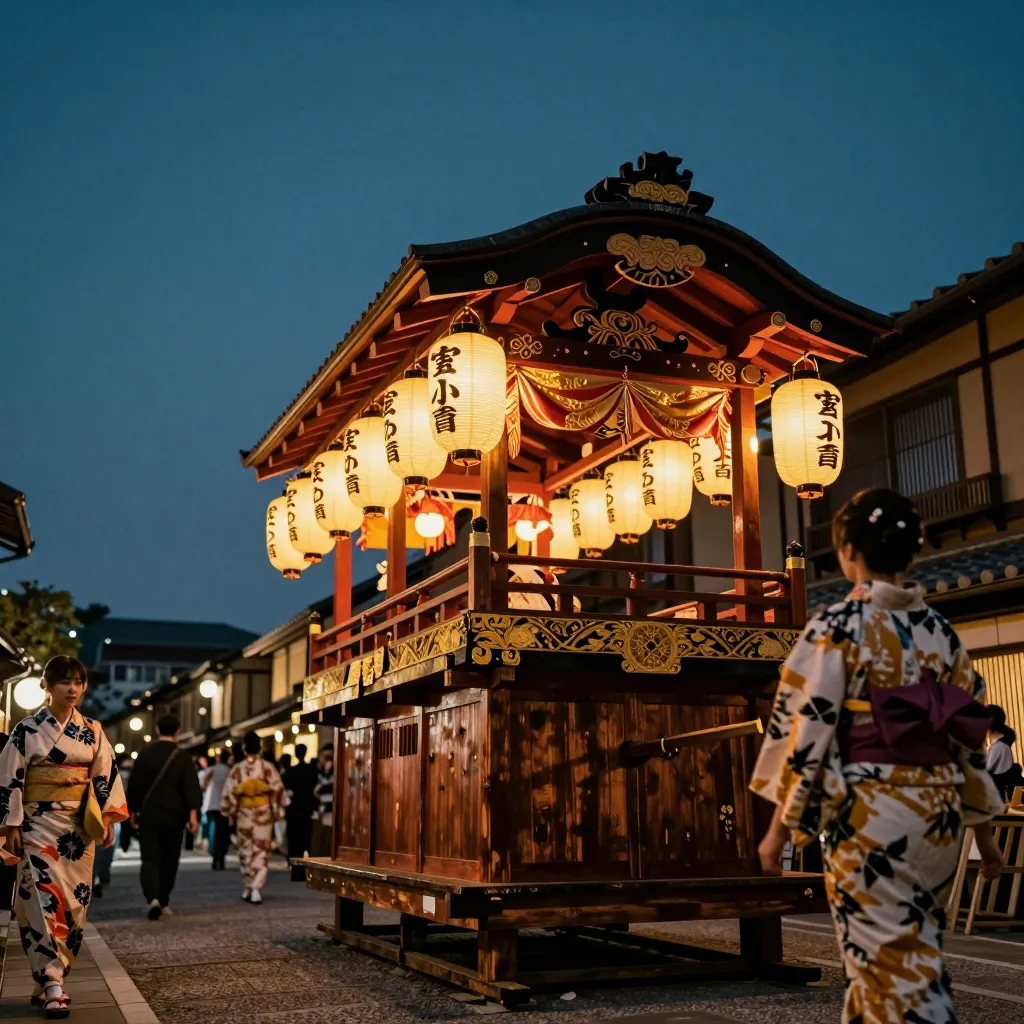
Gion Matsuri (July) [cite_start]Kyoto’s most significant event spans the entire month of July, peaking with massive float processions on July 17 and 24[cite: 187, 189]. [cite_start]The nights leading up to these parades (Yoi-yama) see the streets closed to traffic as people in summer yukata enjoy street food and view the towering, ornately decorated floats[cite: 188, 190].
Gozan no Okuribi (August 16) [cite_start]Commonly known as the Daimonji Fire Festival, this ritual marks the end of the Obon season when ancestral spirits return to the other world[cite: 192]. [cite_start]Five massive bonfires in the shape of kanji characters and other symbols are lit on the mountains surrounding Kyoto, visible from across the city[cite: 193, 195].
Autumn: History and Fire
Autumn Moon Viewing (Mid-September) [cite_start]To celebrate the harvest moon, various shrines like Shimogamo and Kamigamo host evening events featuring traditional music and moon-viewing rituals[cite: 196, 197].
Jidai Matsuri (October 22) [cite_start]The "Festival of the Ages" is a massive historical parade that celebrates Kyoto’s 1,100-year history as the capital[cite: 198, 199]. [cite_start]Over 2,000 participants march from the Imperial Palace to Heian-jingu, wearing meticulously recreated costumes from different eras of Japanese history[cite: 200, 202].
Kurama Fire Festival (October 22) [cite_start]On the same night as the Jidai Matsuri, the mountain village of Kurama hosts an intense, primeval fire ritual[cite: 203]. [cite_start]Men carry enormous flaming torches through the streets, accompanied by the rhythm of drums and chanting, culminating in a gathering at the local shrine[cite: 205, 206].
Gion Odori (November 1–10) [cite_start]The only major geisha dance held in the autumn, this performance by the Gion Higashi district is prized for its intimate and quaint scale[cite: 208, 209].
Winter Closures: Temple Illuminations and Year-End Bells
Temple Illuminations (March, April, November) [cite_start]To coincide with the cherry blossoms in spring and the fiery maples in autumn, many major temples—including Kiyomizu-dera, Kodai-ji, and Eikan-do—open at night with spectacular lighting displays that highlight the architecture and gardens[cite: 159, 169, 213, 215].
Joya-no-Kane (December 31) [cite_start]As the year ends, Buddhist temples across the city perform the bell-ringing ceremony[cite: 218]. [cite_start]The bells are struck 108 times to symbolize the purging of human desires and bad karma, welcoming the New Year with a clean slate[cite: 219, 220].